
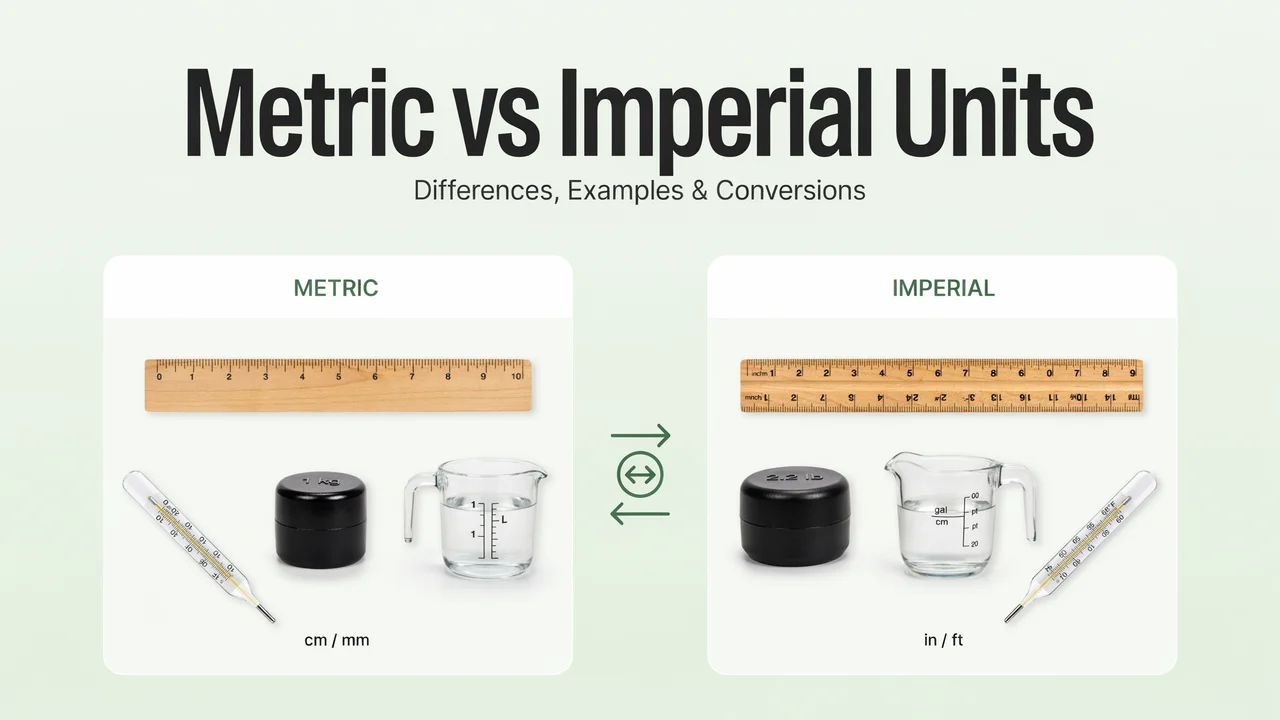
Metric vs Imperial Units: Key Differences, Examples and Conversions
Metric vs imperial units describe two different ways to measure length, mass, volume, temperature, and other quantities.
The metric system uses decimal-based units such as metres, kilograms, and litres. Imperial and US customary systems commonly use inches, feet, pounds, pints, and gallons.
There is one important detail. The United States mainly uses US customary units, not the British Imperial system. The two systems share several unit names, but some values differ.
This guide compares metric vs imperial units, explains common measurements, and shows useful conversion examples.
Metric vs Imperial Units: What Is the Main Difference?
The main difference is how each measurement system is structured. The metric system uses powers of 10. Its prefixes make larger and smaller units easy to relate.
For example:
- 1,000 millimetres = 1 metre
- 100 centimetres = 1 metre
- 1,000 metres = 1 kilometre
- 1,000 grams = 1 kilogram
- 1,000 millilitres = 1 litre
Imperial and US customary units do not follow one consistent decimal pattern.
For example:
- 12 inches = 1 foot
- 3 feet = 1 yard
- 1,760 yards = 1 mile
- 16 ounces = 1 pound
This difference makes metric scaling easier in many calculations.
Metric System at a Glance
The modern international measurement system is known as SI, or the International System of Units.
Common everyday metric units include:
- millimetres and centimetres for small lengths
- metres for height and distance
- kilometres for longer distances
- grams and kilograms for mass
- millilitres and litres for volume
- degrees Celsius for everyday temperature
Metric prefixes indicate decimal multiples or fractions of a unit. For example, kilo represents 1,000 times a unit, while milli represents one-thousandth.
Imperial and US Customary Systems at a Glance
Common units include:
- inches
- feet
- yards
- miles
- ounces
- pounds
- fluid ounces
- pints
- quarts
- gallons
- degrees Fahrenheit
British Imperial and US customary measurements developed from related older systems.
However, they are not identical. The difference becomes especially important with liquid volume measurements.
Metric vs Imperial Comparison Chart
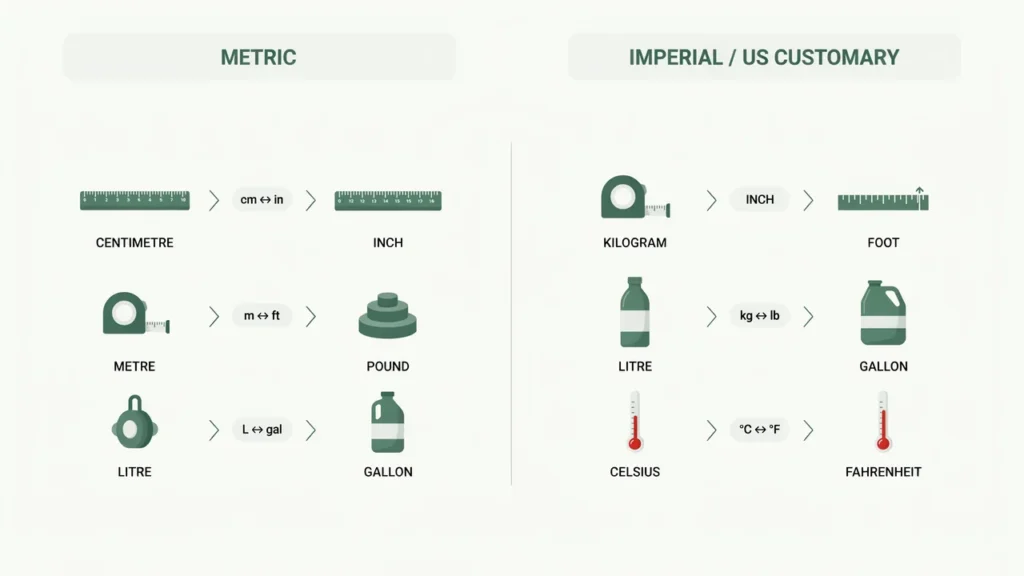
This table shows common units from each measurement system.
| Measurement | Metric units | Imperial / US customary units |
|---|---|---|
| Length | mm, cm, m, km | in, ft, yd, mi |
| Mass / everyday weight | mg, g, kg | oz, lb |
| Volume | mL, L | fl oz, pt, qt, gal |
| Temperature | °C | °F |
Length units often convert consistently between British Imperial and US customary measurements.
Volume needs more care.
A US gallon and an Imperial gallon are not the same size. Their fluid ounces and pints also differ.
Common Metric Units and Their Examples
Metric units appear in science, trade, medicine, transport, food packaging, and daily measurements around the world.
Length
Common metric length units include:
- millimetre (mm)
- centimetre (cm)
- metre (m)
- kilometre (km)
A millimetre works well for small dimensions.
Centimetres are common for objects and body measurements. Metres suit room dimensions and shorter distances. Kilometres are normally used for road and travel distances in metric countries.
For example:
- a small object may measure 25 mm
- a table may be 120 cm long
- a room may be 4 m wide
- a journey may cover 20 km
For exact conversions between centimetres, metres, kilometres, inches, feet, and miles, use the Length Converter.
Mass and Weight
Common metric units include:
- milligram (mg)
- gram (g)
- kilogram (kg)
Milligrams are useful for very small quantities. Grams often appear on food labels and recipes. Kilograms are widely used for body weight, luggage, and heavier objects.
Technically, kilograms measure mass. In everyday conversation, people often describe kilograms as a measure of weight.
You can convert grams, kilograms, ounces, pounds, and other units with the Weight Converter.
Volume
Common metric volume units include:
- millilitre (mL)
- litre (L)
A millilitre is useful for small liquid quantities.
Litres are common for drinks, fuel, cooking ingredients, and container capacity.
For example:
- a medicine dose may contain a few millilitres
- a drink bottle may hold 500 mL
- a large bottle may hold 2 L
Use the Volume Converter when converting litres, millilitres, gallons, pints, or fluid ounces.
Temperature
Degrees Celsius are commonly used for everyday temperatures in countries using metric measurements.
Water freezes at 0°C under standard reference conditions, while 100°C is commonly used as the boiling point reference at standard atmospheric pressure.
Temperature conversion needs a formula because Celsius and Fahrenheit use different scale intervals and starting points.
Use the Temperature Converter when you need an exact result.
Common Imperial and US Customary Units
Imperial and US customary units still appear in daily life, especially in the United States and some UK contexts.
Length Units
Common length units include:
- inch
- foot
- yard
- mile
The basic relationships are:
- 12 inches = 1 foot
- 3 feet = 1 yard
- 1,760 yards = 1 mile
- 5,280 feet = 1 mile
Inches are useful for smaller objects. Feet are often used for height and room dimensions. Miles measure longer road distances.
Weight and Mass Units
Common units include:
- ounce (oz)
- pound (lb)
The relationship is:
16 ounces = 1 pound
The stone is also still used informally for body weight in some UK contexts. One stone equals 14 pounds.
Volume Units
Common units include:
- fluid ounce
- pint
- quart
- gallon
These require extra attention because the US and British Imperial definitions are different. A US gallon is smaller than an Imperial gallon. The same issue affects pints and fluid ounces.
Temperature
Degrees Fahrenheit are widely used for everyday weather and household temperatures in the United States.
For example:
- 32°F equals 0°C
- 68°F equals 20°C
- 212°F equals 100°C
US Customary vs British Imperial Units
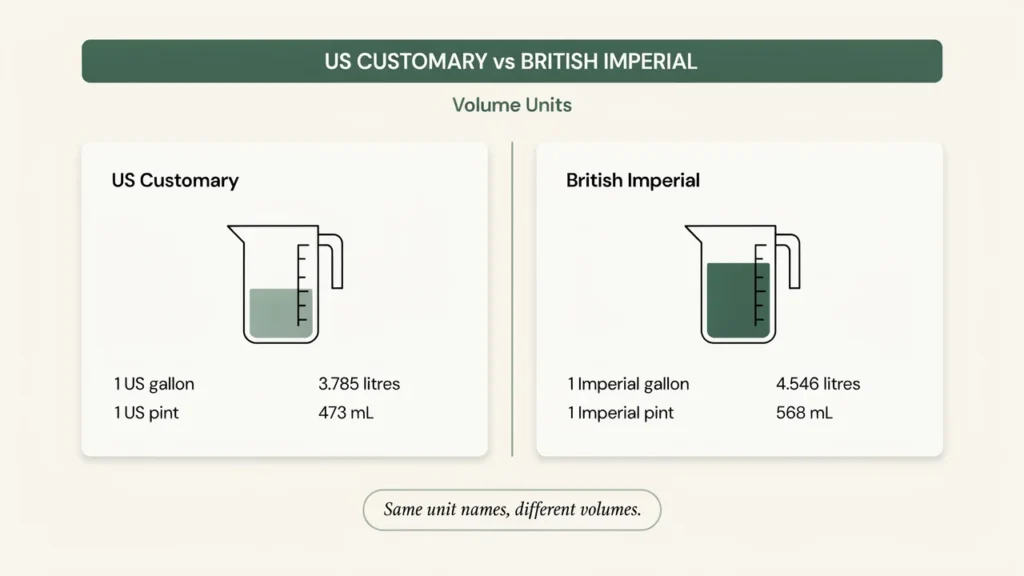
US customary and British Imperial units are related, but they should not be treated as one identical system. Many length units share the same modern definitions.
For example:
- inch
- foot
- yard
- mile
Volume units are where the difference becomes much more noticeable.
| Unit | US customary | British Imperial |
|---|---|---|
| Gallon | about 3.785 L | about 4.546 L |
| Pint | about 473 mL | about 568 mL |
| Fluid ounce | about 29.57 mL | about 28.41 mL |
This difference matters when reading:
- recipes
- fuel economy data
- container sizes
- drink measurements
- older technical documents
If a conversion includes gallons, pints, or fluid ounces, check whether the source means US customary or Imperial.
Common Metric to Imperial Conversion Examples
These conversions are useful for everyday estimates.
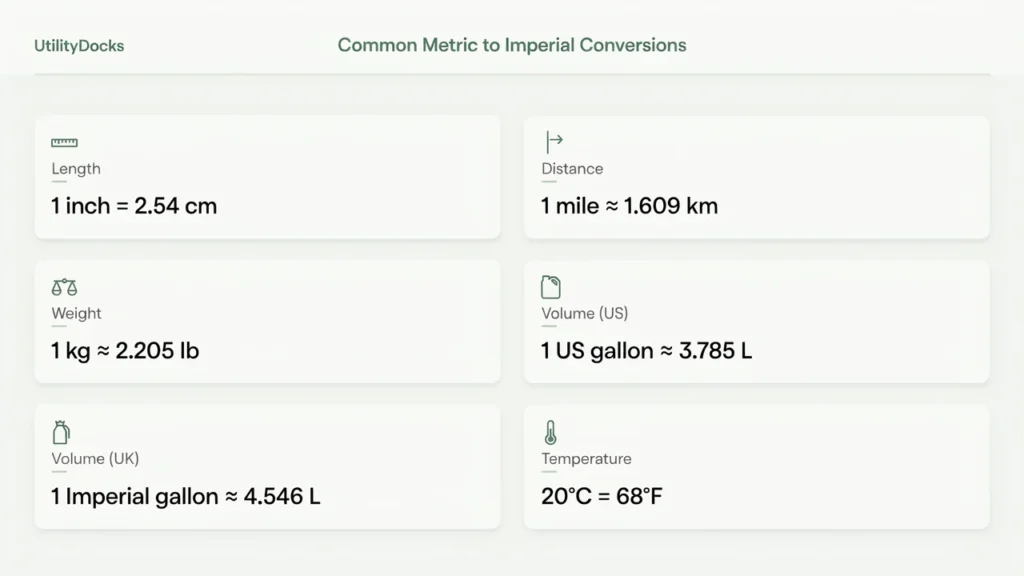
| Convert | Result |
|---|---|
| 1 inch | 2.54 cm |
| 1 foot | 30.48 cm |
| 1 metre | about 3.281 ft |
| 1 mile | about 1.609 km |
| 1 kilogram | about 2.205 lb |
| 1 pound | about 0.454 kg |
| 1 litre | about 0.264 US gal |
| 1 US gallon | about 3.785 L |
| 1 Imperial gallon | about 4.546 L |
Some conversions are exact definitions, while displayed decimal results may be rounded for practical use. Use a dedicated converter when precision matters.
Metric vs Imperial Length Measurements
Length is one of the easiest places to see the difference between the systems.
Metric measurements commonly use:
- centimetres for smaller dimensions
- metres for rooms and human-scale distances
- kilometres for travel distances
Imperial and US customary measurements commonly use:
- inches
- feet
- yards
- miles
For example:
1 inch = 2.54 centimetres
So 10 inches equals 25.4 centimetres.
Another common conversion is miles to kilometres.
1 mile ≈ 1.609 kilometres
That means:
5 miles ≈ 8.05 kilometres
If you regularly work between both systems, the Length Converter handles these conversions directly.
Metric vs Imperial Weight and Mass Measurements
Kilograms and pounds are among the most common units people need to convert.
A useful relationship is:
1 kilogram ≈ 2.205 pounds
For example:
10 kg is about 22.05 lb.
In the opposite direction:
1 pound ≈ 0.454 kilograms
So:
10 lb is about 4.54 kg.
Grams and ounces are more useful for smaller quantities. One avoirdupois ounce is about 28.35 grams.
Do not confuse an ounce of mass with a fluid ounce. They measure different quantities. Use the Weight Converter for kilograms, pounds, grams, ounces, and other weight or mass units.
Metric vs Imperial Volume Measurements
Volume creates more confusion than most other measurement categories.
The metric system mainly uses:
- millilitres
- litres
US customary and Imperial measurements may use:
- fluid ounces
- pints
- quarts
- gallons
The important issue is that British Imperial and US customary liquid units differ.
For example:
1 US gallon ≈ 3.785 litres
but:
1 Imperial gallon ≈ 4.546 litres
A litre also equals about 33.81 US fluid ounces.
You should therefore avoid entering a value simply as “gallons” unless you know which gallon definition applies.
The Volume Converter can help when working between litres, gallons, pints, and fluid ounces.
Celsius vs Fahrenheit in Metric and Imperial Use
Celsius and Fahrenheit need more than a simple multiplication factor. Their zero points are different, so the conversion formula includes an offset.
To convert Fahrenheit to Celsius:
°C = (°F – 32) ÷ 1.8
To convert Celsius to Fahrenheit:
°F = (°C × 1.8) + 32
For example:
20°C = 68°F
And:
32°F = 0°C
This is different from converting metres to feet or kilograms to pounds.
Does the US Use Metric or Imperial Units?
The United States mainly uses US customary units in everyday life.
Examples include:
- miles for road distances
- feet and inches for height
- pounds for body weight
- gallons for fuel
- Fahrenheit for weather temperatures
However, the US also uses metric measurements in many areas.
Metric units commonly appear in:
- science
- medicine
- pharmaceuticals
- manufacturing
- engineering
- international trade
- product labeling
- nutrition information
For that reason, the answer to “is the US metric or imperial?” needs some context.
The US is not purely metric, and its everyday system is technically US customary, rather than the modern British Imperial system.
Both measurement families may appear depending on the activity.
Where Are Metric and Imperial Units Used Today?
Measurement practices vary by country and context.
Countries Mainly Using Metric Units
The metric system and SI are the international standard for most scientific, technical, commercial, and government measurement.
Most countries use metric units as their primary measurement system.
Common examples include:
- kilometres for road distance
- kilograms for body mass
- litres for liquids
- Celsius for weather
United States
US customary units remain common in everyday American life.
However, metric measurements also appear throughout technical, scientific, medical, and commercial settings. This creates a mixed environment where users often need conversions.
United Kingdom
The United Kingdom also has mixed measurement habits. Metric units are required for most trade measurements. Imperial units still appear in certain legal and everyday contexts.
Examples include:
- miles for road distances
- pints for some draught drinks
- feet and inches in informal height discussions
This is another reason to distinguish everyday usage from the formal measurement system.
Why Is the Metric System Easier to Convert?
Metric units use a consistent decimal structure. This makes many conversions possible by moving between powers of 10.
For example:
1,000 metres = 1 kilometre
1,000 grams = 1 kilogram
1,000 millilitres = 1 litre
Compare this with common Imperial or US customary relationships:
12 inches = 1 foot
3 feet = 1 yard
1,760 yards = 1 mile
There is no single repeated conversion factor. That does not make Imperial units unusable. It simply means conversions often require remembering different relationships.
Common Metric and Imperial Conversion Mistakes
Small unit mistakes can produce large errors. Here are several common problems to avoid.
Treating US and Imperial Gallons as Equal
A US gallon is about 3.785 litres. An Imperial gallon is about 4.546 litres. Always identify which gallon is being used.
Confusing Ounces and Fluid Ounces
An ounce usually measures mass. A fluid ounce measures volume. They cannot be converted directly without information about the substance.
Mixing Mass and Volume
Kilograms and litres measure different quantities. You cannot generally say that one litre equals one kilogram unless the material and its density make that relationship valid for the specific situation.
Using the Wrong Temperature Formula
Celsius and Fahrenheit have different zero points. A simple multiplication is not enough. Use the complete formula or a temperature converter.
Rounding Too Early
Early rounding can affect the final answer. Keep extra decimal places during the calculation, then round the finished result.
Mixing Centimetres and Inches
A measurement such as “20 × 30” is incomplete without units. Always record the unit beside each value.
Confusing Tonne, Short Ton, and Long Ton
These are not equal. A metric tonne, US short ton, and British long ton represent different masses. This topic is better treated separately when an exact ton conversion is required.
Assuming Imperial Always Means American Units
US customary units and British Imperial units share many names. Their liquid volumes can differ, so the terms should not always be used interchangeably.
Quick Metric vs Imperial Conversion Table
Use this table for common estimates.
| Metric / Imperial conversion | Approximate relationship |
|---|---|
| 1 mm | 0.0394 in |
| 1 cm | 0.3937 in |
| 1 m | 3.281 ft |
| 1 km | 0.6214 mi |
| 1 in | 2.54 cm |
| 1 ft | 0.3048 m |
| 1 mi | 1.609 km |
| 1 g | 0.0353 oz |
| 1 kg | 2.205 lb |
| 1 oz | 28.35 g |
| 1 lb | 0.454 kg |
| 1 L | 0.264 US gal |
| 1 US gal | 3.785 L |
| 1 Imperial gal | 4.546 L |
| 20°C | 68°F |
These values are suitable for quick reference.
Use exact conversion tools for engineering, scientific work, manufacturing, or other precision-sensitive calculations.
Metric vs Imperial at a Glance
| Type | Example |
|---|---|
| Length | 1 m ≈ 3.28 ft |
| Weight / mass | 1 kg ≈ 2.20 lb |
| Volume | 1 L ≈ 0.264 US gal |
| Temperature | 20°C = 68°F |
Important: US customary and British Imperial volume units are not identical.
Which Measurement System Should You Use?
Use the measurement system expected for your location, industry, document, or task. For everyday measurements, follow the units people around you normally use.
For technical work, follow the required specification. If a drawing uses millimetres, avoid introducing inches without converting them carefully.
The same principle applies to:
- construction
- engineering
- recipes
- travel
- shipping
- scientific data
- international trade
When sharing measurements internationally, including both units can make information easier to understand.
For calculations, use the relevant UtilityDocks converter instead of estimating manually when precision matters.
Frequently Asked Questions
What Is the Difference Between Metric and Imperial Units?
Metric units use a decimal structure based on powers of 10. Imperial and US customary systems use relationships such as 12 inches per foot and 16 ounces per pound.
Is the US Metric or Imperial?
The US mainly uses US customary units in everyday life. Metric units are also widely used in science, medicine, manufacturing, and other technical fields.
Are US Customary and Imperial Units the Same?
No. They share many unit names, but some definitions differ. Liquid volume units such as gallons, pints, and fluid ounces are important examples.
Is an Inch Metric or Imperial?
An inch belongs to the Imperial and US customary measurement families. One inch equals exactly 2.54 centimetres.
Is a Pound Metric or Imperial?
The pound is used in Imperial and US customary measurement. One avoirdupois pound equals about 0.454 kilograms.
How Many Centimetres Are in One Inch?
One inch equals exactly 2.54 centimetres.
How Many Kilometres Are in One Mile?
One international mile equals about 1.609 kilometres.
Which Is Bigger, a US Gallon or an Imperial Gallon?
An Imperial gallon is larger. A US liquid gallon is about 3.785 litres, while an Imperial gallon is about 4.546 litres.
Why Does Metric Use Powers of 10?
Metric prefixes represent decimal multiples and submultiples. For example, kilo means 1,000 times a unit, while milli means one-thousandth.
Sources and Methodology
Measurement definitions, conversion relationships, and current usage explanations were checked against authoritative measurement and government sources.
Sources used:
- Bureau International des Poids et Mesures (BIPM)
- National Institute of Standards and Technology (NIST)
- UK Government measurement guidance
Approximate values are rounded where that makes everyday comparisons easier.
Metric vs Imperial Units: Key Takeaways
Metric vs imperial units use different structures for measuring the same physical quantities.
Metric units follow a decimal system, making many conversions straightforward.
US customary and British Imperial units share several names, but they are not always identical. Volume units require particular care.
For everyday reference:
- 1 inch = 2.54 cm
- 1 mile ≈ 1.609 km
- 1 kg ≈ 2.205 lb
- 1 US gallon ≈ 3.785 L
- 1 Imperial gallon ≈ 4.546 L
- 20°C = 68°F
When accuracy matters, identify the exact unit system first and use the appropriate converter rather than relying on estimates.