ROI vs Profit: Differences, Formulas and Profit Margin Explained
ROI and profit both help measure financial performance, but they answer different questions.
Profit tells you how much money was earned after relevant costs. ROI shows how much return was generated relative to the amount invested.
Profit margin is another related measure. It compares profit with sales revenue rather than the investment amount.
For example, two projects can each make $5,000 in profit but have very different ROI percentages if one requires much more money to produce that profit.
That difference is why profit, profit margin, and return on investment should not be treated as interchangeable.
ROI vs Profit at a Glance
| Metric | What It Measures | Basic Formula | Result Type |
|---|---|---|---|
| Profit | Money left after relevant costs | Revenue − Costs | Dollar amount |
| Profit Margin | Profit relative to revenue | Profit ÷ Revenue × 100 | Percentage |
| ROI | Return relative to investment | Net Return ÷ Investment Cost × 100 | Percentage |
The main difference comes from the number used as the comparison base.
Profit does not need a comparison base. It is an amount of money.
Profit margin compares profit with revenue.
ROI compares return with the money invested.
What Is Profit?
Profit is the financial amount remaining after costs are deducted from revenue.
A basic formula is:
Profit = Revenue − Costs
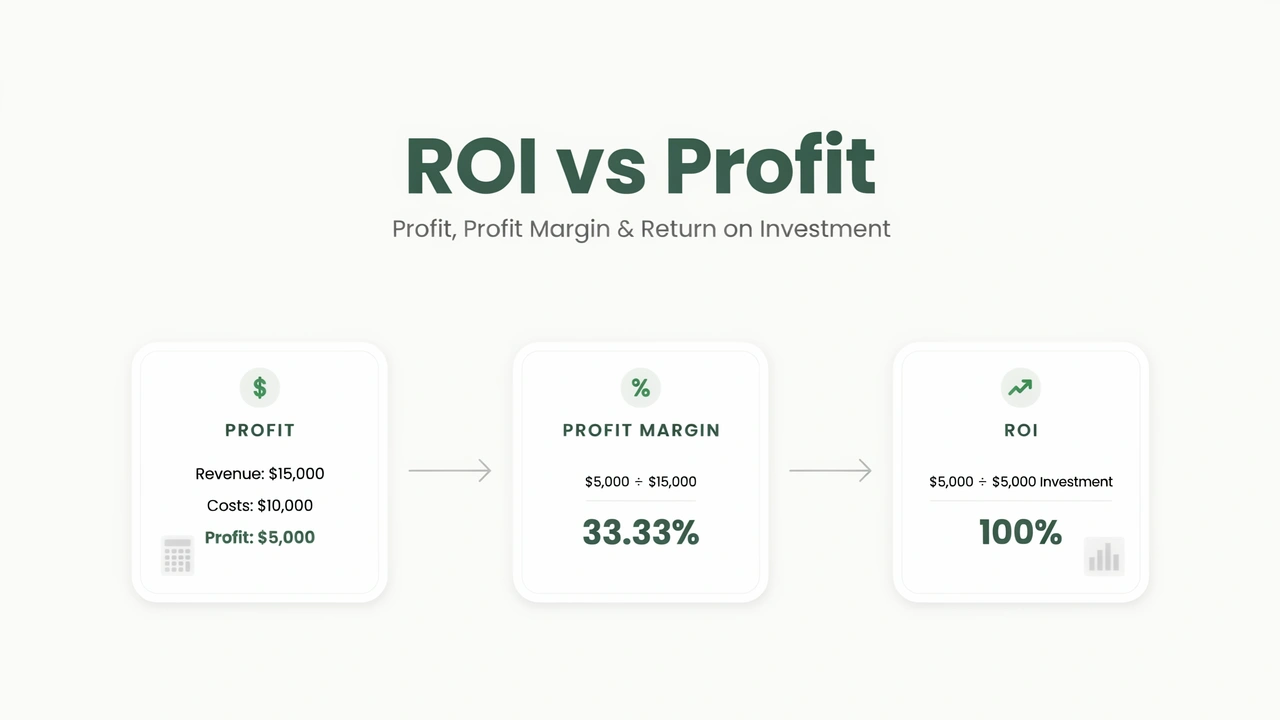
Suppose a business generates $15,000 in revenue and incurs $10,000 in relevant costs.
Profit:
$15,000 − $10,000 = $5,000
The business earned $5,000 in profit.
Profit answers a straightforward question:
How much money did this activity earn after costs?
That makes profit useful when evaluating absolute financial results.
A project that earns $20,000 in profit has generated more money than a project earning $5,000, but that does not automatically mean it used capital more efficiently.
That is where ROI becomes useful.
What Is ROI?
ROI stands for return on investment. It compares the return generated by an investment with the amount of money used to make that investment.
A common simple formula is:
ROI = Net Return ÷ Cost of Investment × 100
Suppose a project requires a $5,000 investment and generates a $2,000 net return.
ROI:
$2,000 ÷ $5,000 × 100 = 40%
The ROI is 40%.
This means the net return equals 40% of the investment base used in the calculation.
If you need to calculate your own percentage, use the ROI Calculator.
Profit Margin Measures Something Different
Profit margin is often confused with ROI because both can be shown as percentages. The difference is the denominator.
Profit margin compares profit with sales revenue. ROI compares return with investment cost.
A common profit margin formula is:
Profit Margin = Profit ÷ Revenue × 100
Suppose:
- Revenue = $15,000
- Profit = $5,000
Profit margin:
$5,000 ÷ $15,000 × 100 = 33.33%
The business therefore keeps about 33.33% of its revenue as profit, based on the profit figure used in the calculation.
For your own revenue and cost figures, use the Profit Margin Calculator.
One Example Showing Profit, ROI and Profit Margin
Consider a project with these figures:
| Item | Amount |
|---|---|
| Revenue | $15,000 |
| Relevant total costs | $10,000 |
| Investment being evaluated | $5,000 |
| Profit | $5,000 |
Step 1: Calculate Profit
$15,000 − $10,000 = $5,000
Profit:
$5,000
Step 2: Calculate Profit Margin
$5,000 ÷ $15,000 × 100 = 33.33%
Profit margin:
33.33%
Step 3: Calculate ROI
If the defined investment base is $5,000:
$5,000 ÷ $5,000 × 100 = 100%
ROI:
100%
The same activity therefore produces three different results:
- Profit: $5,000
- Profit margin: 33.33%
- ROI: 100%
None of these results contradicts the others. They simply measure different relationships. Profit describes the dollar gain. Profit margin describes profit relative to revenue.
ROI describes return relative to the investment base.
Same Profit, Different ROI
One of the easiest ways to understand ROI vs profit is to compare two projects that earn the same amount of money.
Project A
Investment:
$10,000
Profit:
$5,000
ROI:
$5,000 ÷ $10,000 × 100 = 50%
Project B
Investment:
$50,000
Profit:
$5,000
ROI:
$5,000 ÷ $50,000 × 100 = 10%
Comparison:
| Metric | Project A | Project B |
|---|---|---|
| Investment | $10,000 | $50,000 |
| Profit | $5,000 | $5,000 |
| ROI | 50% | 10% |
Both projects earn the same $5,000 profit.
Project A produces a higher ROI because it generates that profit using a smaller investment.
This shows why profit alone does not measure capital efficiency.
Same ROI, Different Profit
The reverse can also happen. Two projects can have exactly the same ROI while producing very different dollar profits.
Project A
Investment:
$10,000
ROI:
20%
Profit:
$2,000
Project B
Investment:
$100,000
ROI:
20%
Profit:
$20,000
Comparison:
| Metric | Project A | Project B |
|---|---|---|
| Investment | $10,000 | $100,000 |
| ROI | 20% | 20% |
| Profit | $2,000 | $20,000 |
Both projects return 20% relative to their investment.
Project B, however, produces ten times as much dollar profit because much more capital is involved. This is why a high or equal ROI does not tell you how many dollars were actually earned.
ROI vs Profit Margin: Why the Percentages Differ
ROI and profit margin can describe the same activity but produce different percentages because they use different bases.
Suppose a product or project has:
- Revenue = $100
- Relevant cost = $60
- Profit = $40
Profit margin:
$40 ÷ $100 × 100 = 40%
If the $60 cost represents the investment base for the ROI calculation:
$40 ÷ $60 × 100 = 66.67%
The result is:
- Profit margin = 40%
- ROI = 66.67%
The $40 profit is the same.
The percentage changes because profit margin divides profit by revenue, while ROI divides return by the investment amount.
This distinction is also why profit margin vs ROI is not a question of choosing one correct percentage. Each metric answers a different question.
Profit vs Profit Margin vs ROI
The three metrics can be summarized this way:
Profit
Question: How much money did we make?
Example:
$20,000 profit
Profit Margin
Question: How much of our sales revenue became profit?
Example:
20% margin
ROI
Question: How much return did we generate relative to the capital invested?
Example:
35% ROI
A business may need all three numbers to understand performance properly.
When Profit Is More Useful Than ROI
Profit is especially useful when the goal is to understand the absolute financial contribution of an activity.
For example, consider two projects:
| Project | Profit | ROI |
|---|---|---|
| A | $5,000 | 50% |
| B | $50,000 | 25% |
Project A has the higher ROI. Project B earns ten times more profit.
Which figure matters more depends on the decision being made.
Profit can be especially useful when comparing:
- total earnings
- contribution to business income
- dollar gains from products
- total financial outcome
- whether an activity produced a gain or loss
ROI adds another layer by showing how much capital was needed to generate that result.
When ROI Is More Useful Than Profit
ROI becomes particularly useful when comparing opportunities that require different levels of investment.
Consider:
- Project A earns $10,000 from a $20,000 investment
- Project B earns $15,000 from a $100,000 investment
Project B generates more profit.
But its ROI is:
$15,000 ÷ $100,000 × 100 = 15%
Project A’s ROI is:
$10,000 ÷ $20,000 × 100 = 50%
ROI reveals that Project A generated substantially more return for each dollar invested.
This can help when comparing:
- projects
- marketing campaigns
- equipment purchases
- product launches
- business investments
- alternative uses of limited capital
ROI is therefore useful for measuring relative efficiency, while profit shows the absolute financial result.
Why the ROI Investment Base Matters
An ROI percentage is only meaningful when the investment base is clearly defined.
Depending on what is being analyzed, the investment may include:
- purchase cost
- advertising spend
- installation expenses
- setup costs
- transaction fees
- implementation expenses
- other directly related costs
Leaving relevant costs out can make ROI appear higher than it really is.
For example:
Investment cost before fees:
$10,000
Profit:
$3,000
Calculated ROI:
30%
Now suppose another $2,000 of required implementation costs should have been included.
Actual investment base:
$12,000
Recalculated ROI:
$3,000 ÷ $12,000 × 100 = 25%
The return did not change.
The more complete investment base changed the ROI from 30% to 25%.
For meaningful comparisons, the same cost logic should be applied consistently.
Can Profit Increase While ROI Falls?
Yes.
Profit and ROI can move in different directions.
Suppose a business originally invests $10,000 and earns $4,000.
ROI:
40%
Later it expands the project.
Investment rises to $30,000 and profit rises to $6,000.
Profit increased:
$4,000 → $6,000
But ROI becomes:
$6,000 ÷ $30,000 × 100 = 20%
The business earns more dollars but generates less return relative to the amount invested.
That does not automatically mean the expansion was a poor decision. It simply demonstrates why absolute profit and ROI should be interpreted separately.
Why Simple ROI Can Be Misleading
ROI is useful because it is easy to understand, but a simple ROI percentage does not capture every financial consideration.
ROI Does Not Automatically Account for Time
Suppose two investments each produce a 30% ROI.
Investment A produces the return in one year.
Investment B produces the same return in five years.
Their simple ROI is identical, but the time required to achieve the result is very different.
For investments with different holding periods, simple ROI alone may therefore provide an incomplete comparison.
Different Cost Definitions Change the Result
One person might calculate ROI using only the purchase price.
Another may include:
- fees
- maintenance
- implementation costs
- transaction expenses
Those calculations can produce different ROI percentages even when they describe the same underlying investment.
ROI Does Not Directly Show Dollar Scale
A 100% ROI sounds impressive, but the dollar result could still be small.
For example:
$100 investment
$100 profit
ROI:
100%
Compare that with:
$100,000 investment
$20,000 profit
ROI:
20%
The first investment has the higher ROI.
The second produces $19,900 more profit.
Both pieces of information matter.
Is Higher ROI Always Better?
A higher ROI means a larger return relative to the defined investment base.
It does not automatically mean one option is superior in every respect.
A meaningful decision may also depend on:
- total profit
- time period
- risk
- cash requirements
- available capital
- reliability of expected returns
- other business priorities
For example, a small project may generate a very high ROI but contribute little total profit.
A larger project may have a lower ROI while producing significantly more dollars.
ROI should therefore be interpreted as one financial measure, not as a complete decision by itself.
Common ROI and Profit Mix-Ups
Treating Profit as ROI
A $10,000 profit is not a 10,000% ROI.
Profit is a dollar amount.
ROI requires an investment base.
If $10,000 profit came from a $50,000 investment:
ROI = $10,000 ÷ $50,000 × 100 = 20%
Treating Profit Margin as ROI
Profit margin uses revenue as the denominator.
ROI uses investment cost.
A 25% profit margin does not automatically mean the investment has a 25% ROI.
Comparing ROI With Different Cost Definitions
One ROI calculation might include all project costs while another includes only the initial purchase.
That creates an inconsistent comparison.
Define the investment base before comparing percentages.
Ignoring Time
A 20% ROI generated in a short period and a 20% ROI generated over many years should not automatically be treated as equivalent.
Looking Only at the Highest Percentage
A higher percentage can hide a much smaller dollar result.
Check profit as well as ROI before interpreting performance.
A Simple Way to Remember ROI vs Profit
Use these questions:
Profit: How much money did we earn?
Profit margin: How much of our sales became profit?
ROI: How much return did we generate for the money invested?
The formulas reinforce the same distinction:
Profit = Revenue − Costs
Profit Margin = Profit ÷ Revenue × 100
ROI = Net Return ÷ Investment Cost × 100
Frequently Asked Questions
What is the difference between ROI and profit?
Profit is the amount of money earned after relevant costs are deducted from revenue. ROI compares a return with the amount invested and expresses the result as a percentage.
Is ROI the same as profit margin?
No.
Profit margin divides profit by revenue.
ROI divides return by the investment base.
Because the denominators are different, the percentages can differ substantially.
Can profit increase while ROI decreases?
Yes.
If the amount invested grows faster than profit, dollar profit can increase while ROI declines.
For example, profit may rise from $4,000 to $6,000 while investment rises from $10,000 to $30,000. ROI would fall from 40% to 20%.
Can two projects have the same ROI but different profit?
Yes.
A $10,000 investment earning 20% produces $2,000 in return.
A $100,000 investment earning the same 20% produces $20,000.
The ROI is identical, but the dollar result is different.
Can ROI be over 100%?
Yes.
If net return exceeds the investment amount, simple ROI can exceed 100%.
For example, a $10,000 investment producing a $15,000 net return has:
$15,000 ÷ $10,000 × 100 = 150% ROI
Does ROI include time?
Simple ROI does not automatically account for how long it takes to earn the return.
This is an important limitation when comparing investments with different time periods.
What costs should be included in ROI?
The appropriate investment base depends on what is being measured.
Relevant costs may include the initial investment and other costs directly required to produce the return. The important point is to define the investment base clearly and apply the same approach when comparing alternatives.
Is a higher ROI always better?
A higher ROI indicates a greater return relative to the investment base, but it does not by itself account for dollar profit, time, risk, capital requirements, or other business considerations.
What is more important, ROI or profit?
Neither is universally more important.
Profit shows the absolute amount earned.
ROI shows return relative to investment.
The more useful measure depends on the decision being evaluated.
ROI and Profit Answer Different Financial Questions
The key difference in ROI vs profit is what each number is designed to show. Profit measures the financial gain in dollars.
ROI measures return relative to the investment required to generate it. Profit margin adds another perspective by measuring profit relative to revenue.
A complete comparison may therefore require all three:
- Profit for the dollar result
- Profit margin for profitability relative to sales
- ROI for return relative to invested capital
Using the appropriate measure makes it easier to distinguish between an activity that earns more money and one that uses invested capital more efficiently.
For your own figures, use the ROI Calculator and Profit Margin Calculator. For another closely related pricing comparison, see Profit Margin vs Markup. You can also browse more business tools and guides in Business & Pricing.
Sources Used for Fact Checking
- OpenStax, Principles of Economics
- OpenStax, Principles of Accounting
- Corporate Finance Institute, Return on Investment